Before you order another Gunnebo lifting hook, stop and check the product markings. That one step would have saved us a $1,800 mistake in 2023. I've been managing purchasing for a 160-person industrial services company for five years. Gunnebo products look simple online, but buying them responsibly is not like ordering office supplies.
I'm the office administrator, and I handle roughly $400,000 in annual purchases across vendors in different categories. I report to both operations and finance, which means I answer for schedule misses and invoice mistakes. When I took over purchasing in 2021, I assumed a recognizable brand and a clear photo were enough. Then a rush order arrived with components that looked right but lacked matching documentation. Our operations manager caught it before anything went into service. It still cost us a day of delays and a $1,800 return.
My rule now is short: no clear identification, no order. I'm not saying the logo has to be visible in the listing. I mean the product markings, grade, and supplier paperwork should all point to the same item. It sounds fussy. The fussiness is what saves money.
What I check before buying Gunnebo products
Gunnebo's range includes lifting hooks, shackles, swivel hooks, safety hooks, rigging components, and container lifting lugs. That is one reason a lot of procurement people like the brand: you can standardize on a range from one quality-minded manufacturer. But standardization only works if you verify part numbers. Gunnebo on an invoice is not a specification.
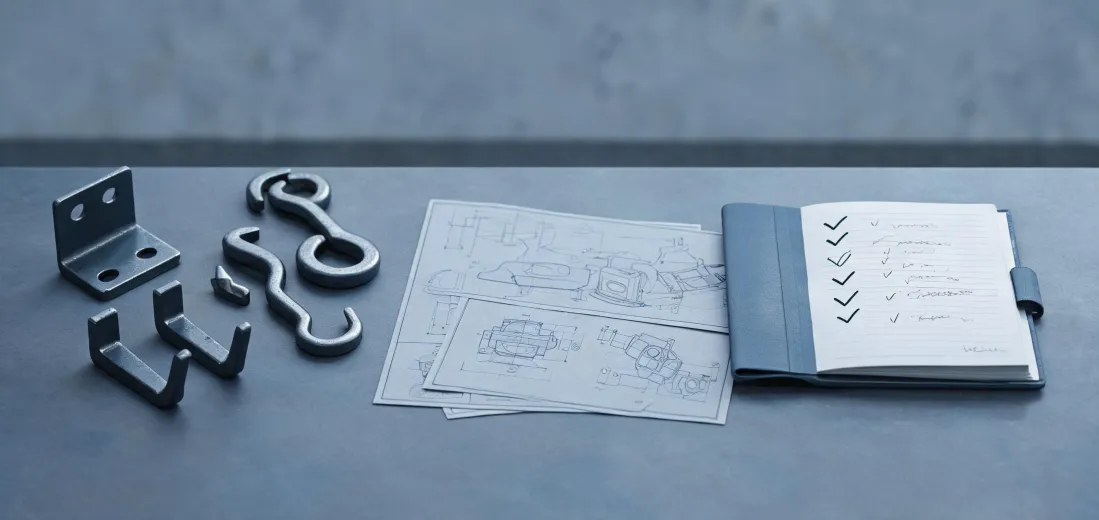
Here is the checklist I use for any Gunnebo product:
- Product markings are present and legible: size, grade, batch identification, and manufacturer identifier. No markings, no order.
- The working load limit is stated in the listing or datasheet. Breaking load alone does not tell me how the component may be used.
- The supplier can name the standard that applies. For forged lifting components in Europe, EN 1677-1 is common. In the United States, ASME B30.26 is often referenced for rigging hardware (Source: asme.org). A supplier that cannot answer this question is not ready for my purchase order.
- The invoice or delivery note references the product number and any certificate. If a product is described as 'Gunnebo type,' that is a red flag, not a shortcut.
The supplier conversation I messed up
I learned this by failing in a smaller way in 2022. I called a supplier and said I needed Gunnebo shackles. They heard bow shackles, because that is what they stocked. I meant screw-pin shackles, the kind our slings had used in past jobs. Both of us used the same word and meant different things. We discovered the mismatch when the order arrived and the pin diameter did not fit our hardware.
That failure was not a huge financial loss. It made me look careless to our operations manager, and it delayed a crew. Since then, I read back the product number, the pin type, and the quantity in my confirmation email. If the supplier's confirmation does not match, I ask before I approve.
The actual cost of skipping verification
People assume certified lifting components cost more because of brand marketing. The actual causation runs the other way: a manufacturer who invests in testing, traceability, and quality control can charge more because the product is dependable. That does not mean every expensive component is good. It means price alone is useless.
In 2023, I almost ordered a cheaper set of shackles from a new vendor to save $1,100. The quotation looked legitimate. When I asked for markings and a batch number, the answer was vague. I cancelled the order. The best case was saving $1,100. The worst case was an untraceable component on a lifting job. Even if the part would have worked, I could not prove it was correct in an audit.
In our 2024 vendor consolidation project, I asked four vendors to quote the same Gunnebo product. The highest quote was about 40% above the lowest. Only two vendors could explain the relevant standard and provide traceability. That gap told me more than the price difference.
Bottom line: a checklist is the cheapest insurance I have. Five minutes of verification beats five days of correction.
Non-lifting requests still follow the same logic
This habit also applies when I'm ordering an air compressor pump rebuild kit or a cordless hammer drill/drive kit hd6280b-11. I may not know the internal difference between two pump kits, but I know enough to look for the exact manufacturer part number. If a listing says compatible with instead of a real part number, I keep looking. The power tool purchase carries less physical risk, but the verification habit is the same.
Where can I buy welding machine safety equipment?
A coworker asked me that exact question last year. My answer was the same one I give for Gunnebo products: use a supplier who can identify the standard behind the product. For welding machine safety equipment, that could mean the screen or shield rating, the electrical safety requirement, or the ventilation product needed. The supplier should explain why the item meets the requirement, not just repeat a marketing line.
When I say certified, I do not mean a glossy PDF in the inbox. I mean the paperwork points back to one specific component, one standard, and one manufacturer. That is the part an admin buyer can verify without being an engineer.
Boundaries and one clarification
I am an administrative buyer, not a lifting engineer or a compliance officer. This checklist prevents obvious procurement mistakes. It does not replace the judgement of a qualified person who knows the application. When there is any doubt about load path, environment, service conditions, or inspection requirements, ask a qualified person before the component goes into service.
One clarification: Gunnebo House and Gardens, the 18th-century manor in Mölndal, Sweden, is not the industrial Gunnebo brand I am describing. If you arrived looking for the estate, you're browsing the wrong aisle. If you are buying rigging hardware, start with markings and documentation.
I still make purchasing mistakes. The difference is I make more of them before the order instead of after it arrives. That is the point of a procurement checklist.