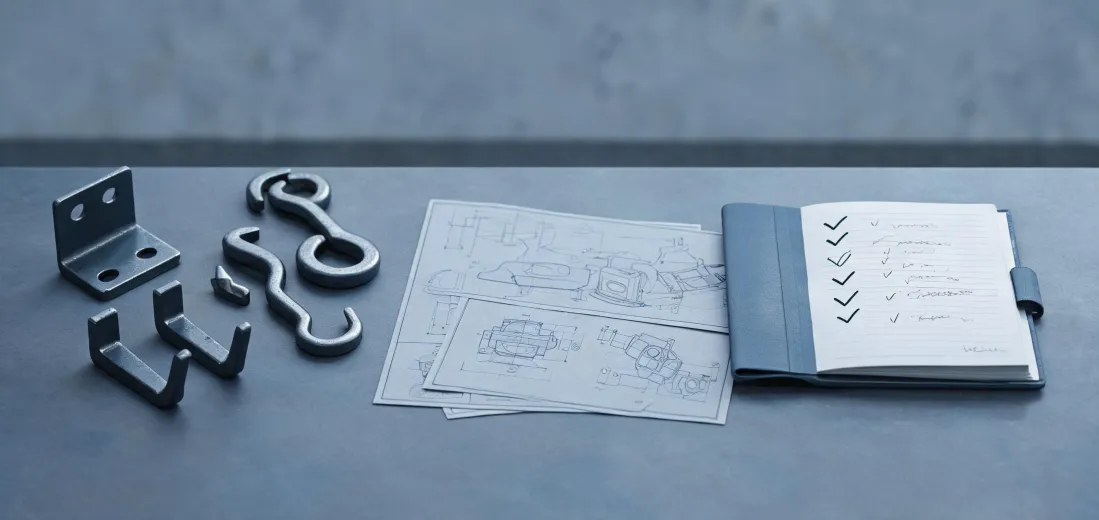
I'll say it plainly: the value of a Gunnebo safety hook is not the hook—it's the documentation behind it. I coordinate emergency procurement for industrial and marine projects. In the past ten years, I've handled more than 200 rush orders for lifting components, including same-day turnarounds for marine clients who needed certified hardware at the dock. When I tell people that, they assume my job is about speed. It isn't. My job is about knowing which suppliers can deliver the right piece of steel with the right proof.
The market has changed. What was best practice in 2020 may not apply in 2026. The fundamentals—load, angle, working load limit (WLL), inspection—haven't moved. But the execution has transformed. Today, certification paperwork is part of the product. If you buy lifting gear without it, you haven't made a low-cost decision. You've made a high-risk one.
Why the cheapest hook is the most expensive part
People think cheap components save money because the invoice is lower. Actually, the opposite is true. The invoice isn't the cost. The cost includes a failed lift, an idle crew, a damaged load, a full site audit, and a shutdown. People think expensive certified hardware costs more because the manufacturer wants more margin. In reality, certified hardware costs more because someone has to run proof tests, maintain heat traceability, and carry product liability. That's not marketing. That's the actual cost of a safe lifting component.
The Gunnebo safety hook is a good example. It's not just a hook with a latch. The latch geometry, the grade of steel, the forging process, and the marking are all engineered around one goal: keep the sling in the saddle of the hook under a moving load—which is where real rigging failures happen, not in a static shelf test. I'd argue that a self-closing safety hook is worth the premium even before you factor in the certificate.
A G 2130 shackle is not a commodity
Let's talk about the G 2130 shackle. That part number is shorthand for a bolt-type anchor shackle, the classic forged bow shackle with a threaded pin. It's the shape most people picture when they hear the word shackle. And it's also the place where a lot of purchasing takes a wrong turn.
From a distance, a G2130 shackle from a certified manufacturer and one from a no-name supplier look identical. But the difference isn't visual. The certified shackle has a working load limit marked on it, a grade mark, a manufacturer identifier, and a heat or batch number that connects it to a test certificate. The no-name shackle has a paint job. That's not an exaggeration. I've seen dozens of 'rated' shackles that arrived with no paperwork and no way to verify what they were actually rated for.
When you cross-reference a G2130 part, don't just match the pin diameter. Check whether the supplier can give you the documentation for that exact heat lot. If they can't, then you're not buying a certified component. You're buying a look-alike with unknown chemistry and unknown proof test history.
Gunnebo container lifting lugs: no room for substitution
Container lifting lugs are a different animal than ordinary hooks. A lug is a lifting point that transfers load through a pin or bore. If the bore wears, the pin doesn't sit properly, or the lug was welded by someone without a qualified procedure, the entire lifting point can be compromised. A Gunnebo container lifting lug is engineered to be used as part of a controlled lifting system—not as a convenience bracket.
Here's a story that made me a believer. In March 2024, a contractor called on a Thursday afternoon. They had a cargo container to lift before a Monday boarding window. Their existing lug had been 'repaired' at a local shop, meaning someone had welded a plate onto it. That's a red flag I've seen before. When a certified lifting component is rewelded, its heat treatment and load path are no longer verifiable. The component has to be retired.
We located a Gunnebo distributor with the correct lug, arranged overnight courier, and paid $240 extra in freight on top of the $1,480 component cost. The contractor got the lug by Friday evening. The alternative was a missed sailing and a delay that would have run into the low five figures. That math was easy. The hardest part of the transaction wasn't the shipping. It was finding a supplier who had a genuine Gunnebo lug with the required documentation.
The 'where can I buy' question gets the problem backwards
People ask me a version of the same question every month: where can i buy welding machine safety equipment. It sounds like a sourcing question. But the actual problem is not the store. The problem is verifying that the equipment is rated for the job and that the supplier is prepared to stand behind it with documentation. Same for lifting hardware.
If someone asks where to buy a Gunnebo safety hook, the serious answer is: from a distributor who sends the certificate with the part. Not from a marketplace seller who can't tell you the difference between EN 1677-1 and a phone number. The search is easy. Verification is the job.
What I've seen fail in the field
In my first year, I made the classic substitution error. A client needed a Gunnebo safety hook quickly, the usual supplier was out of stock, and I approved a different hook with the same working load limit. It looked fine. It failed a third-party inspection because the latch geometry didn't match the application. That mistake cost us a 28-day quarantine of the equipment and a bruised relationship. Nobody got hurt—but that was luck, not diligence.
That's when we implemented a new policy: no certified lifting component gets substituted without a technical review and a certificate. If the component doesn't arrive with documentation, it doesn't go to site. That policy has slowed us down a little. It also means I haven't had a rush-order failure since 2019.
You might be thinking: fine, but I can buy a G2130 shackle online in two days and inspect it when it arrives. You can. But visual inspection is necessary, not sufficient. You can't tell the chemical composition, the heat treatment, or the proof test history by looking at a surface. A $40 shackle can shut down a $2,000-an-hour crew while someone tries to chase paperwork. The $40 part doesn't save money. It just moves the cost into delay and doubt.
The old rule doesn't hold in 2026
Fifteen years ago, you could call a supply house, describe the load, and get a hook delivered on a handshake. That world is gone. Buyers, inspectors, insurers, and regulators want traceability. They want a paper trail that runs from the foundry to the lifting point. If your supply chain can't produce that trail, you don't have a certified component. You have a piece of steel of unknown origin.
Does that mean Gunnebo is the only brand worth buying? No. I've specified Gunnebo components for years—or rather, I've specified them when the application required a certified safety latch and a traceable part number. There are other certified manufacturers doing good work. But I have repeatedly specified Gunnebo safety hooks, G2130-style shackles, and Gunnebo container lifting lugs when the application demanded a known standard and a clean document trail. The Swedish engineering design is a starting point. The certification is the finish line.
So when you search for lifting hardware, don't ask where to buy it. Ask what proof comes with it. A Gunnebo safety hook is an engineered lifting component. The certificate is what makes it safe to specify, inspect, and lift with. That's the product. The hook is just the shape it comes in.