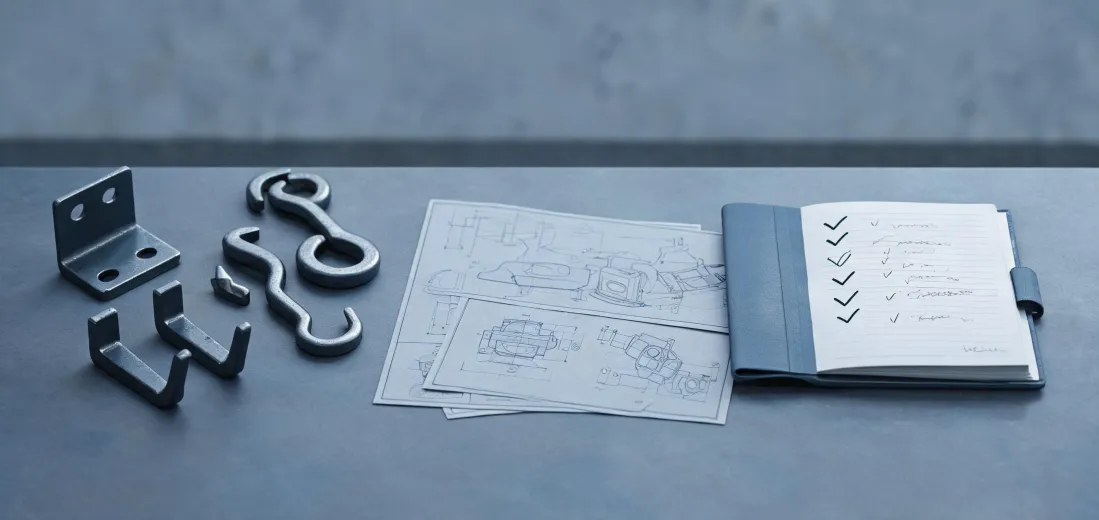
It was a Tuesday morning in late January 2025 when Omar from operations dropped a folder on my desk. "We need lifting points on all twelve container frames," he said. "And the certification inspector is booked for March 14th." I flipped through the folder — rough drawings, part numbers, deadlines. Six weeks felt like forever back then.
Let me explain where I sit. I'm the office administrator for a 200-person logistics company. I manage all parts and equipment purchasing — roughly $80,000 annually across eight vendors, and I report to both operations and finance. That means I hear "move faster" from one side and "spend less" from the other. I'm used to it by now.
Lifting gear wasn't exactly my specialty. I'd bought standard rigging before — slings, hooks, eyebolts — but container lifting lugs were new territory. Omar's drawing showed the lug dimensions, but a lot of it looked like gibberish to me. I figured I'd find something close enough online and be done with it.
That was mistake number one.
Finding the Brand
I started with a search for "gunnebo sweden hook" because one of our riggers mentioned they'd used Gunnebo gear at a previous job. His exact words: "If you're gonna lift containers, you don't mess around with no-name hardware." Fair point.
Gunnebo's site is — how do I put this — thorough. Swedish engineering quality, complete range, all of that. But thorough also means a lot of spec sheets to wade through. I found the section for container lifting components and started comparing part numbers. About two hours in, my head was spinning with working load limits, safety factors, and lift angle ratings.
I called the distributor and ordered what I thought was right — twelve gunnebo container lifting lugs with the swivel lifting eyes. The total came to about $1,400 with shipping (this was early 2025; prices may have moved since). The distributor asked if I'd verified the mounting dimensions against the frame structure. I said yes. I hadn't.
The Ripple Effects
While I was at it, I figured I'd knock out the other maintenance requests that had piled up on my desk. The warehouse crew needed a lift check valve for the hydraulic lift table — you know, the thing that keeps a raised load from dropping if a hose blows. I ordered a standard one after a quick call to a hydraulic supplier. In and out, ten minutes.
The maintenance supervisor also asked for a woodzig hooked saw blade 15 inch. That one was easy — the same part was on their last order, so I copied the line item and shipped it with a rush delivery because he said they were mid-project on some shelving.
All in a day's work. I remember closing my laptop that afternoon feeling pretty good about myself. Three requests, three orders, done. Way ahead of schedule. That's what I get for thinking that.
When It All Went Sideways
The Gunnebo lugs showed up about a week and a half later. I was actually impressed. Heavy plates, solid weld quality, clear markings on every label. Definitely not the cheap stuff.
Omar came by to inspect them. He looked at the paperwork, then picked up a lug, then looked at the paperwork again. That silence is never good.
"These are rated for a 45-degree lift," he finally said. "Our frames sit at a 60-degree angle when the truck lifts them."
I blinked. "So?"
"So the working load limit drops when the angle changes. And the inspector won't accept them." He held up the drawing he'd given me and pointed to a dimension callout. "Also, these mounting holes don't line up with our frame brackets. Different spacing."
There it was, clear as day on a drawing I'd barely looked at. I'd ordered based on the shiny product photos instead of the actual numbers.
The distributor took the lugs back, to his credit. But between restocking fees, freight, and the rush order for the correct ones, I ate about $600. More importantly, we lost ten days. Ten days I didn't have, because March 14th was not moving.
So that was my cure for the "I'm efficient" fantasy. Skipped five minutes of spec verification per order. Cost me $600, a round of stress, and a crash course in lift engineering. The 12-point checklist I created after that mistake has saved us an estimated $8,000 in potential rework since.
The Smaller Headaches
The lift check valve turned out to be the wrong thread size — the lift table needed a specific fitting I hadn't asked about. That was a $90 lesson in writing down model numbers. And the saw blade situation? The maintenance supervisor actually needed his old blade re-sharpened, not a replacement. Though I'll say this: the woodzig hooked saw blade 15 inch did get used eventually, when the crew had to cut through some old pallet framing. So at least that one wasn't a total loss.
Something else stuck with me from that week. One of the mechanics came into my office and asked, "Can I use an impact driver for lug nuts?" He'd just bought one and wanted to try it on a piece of equipment with a loose wheel.
"I mean, you can," I said, "but you probably shouldn't." An impact driver doesn't give you precise torque control. You'll end up with lug nuts either hand-tight with a prayer, or so torqued that you've stretched the studs. I told him to run them down with the driver, then finish with a torque wrench. He looked at me funny, like, where does an office guy get off telling me about torque? But he listened.
(Note to self: funny how I can tell other people to verify their specs while skipping my own.)
What I Actually Learned
If you're reading this because you're in the same spot I was — the person who has to order lifting gear without being an engineer, and the "gunnebo container lifting lugs" search brought you here — here's my honest advice:
- Get the drawing first. Not a verbal description, not a photo. A drawing with dimensions. If the person requesting can't provide one, that's a red flag that they don't know what they need either.
- Ask about the working load limit at your actual lift angle. Gunnebo publishes load charts for different configurations. Find them. Read them. The rating in the product photo might not be the rating for your setup.
- Check bolt-hole spacing against your existing mounting points. I know it sounds basic. I skipped it anyway. Don't be me.
- Don't batch unrelated maintenance items into one "I'm being productive" run. The lugs, the check valve, and the saw blade all landed on my desk the same day, and I gave them the same level of attention — which was not enough. A saw blade reorder is low risk. A lifting component is not.
The corrected Gunnebo lugs arrived twelve days before the inspection. Omar and I double-checked every dimension together, then I watched the riggers bolt them on. The certification passed without a single finding.
And yes, I keep that impact driver answer ready, because about every three months someone asks again. The answer is still no. Use the right tool for the job — which is the same lesson the lugs taught me, just in a smaller package.
Five minutes of verification beats five days of correction. That's the cheapest insurance I'll ever buy.
That $600 hurt at the time. Looking back, it was a pretty cheap way to learn it.