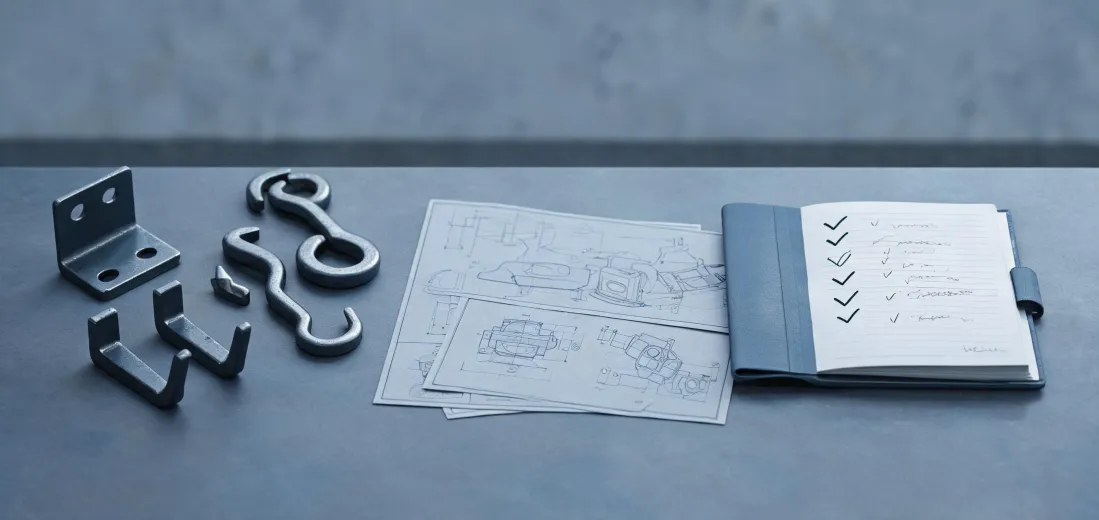
When a customer calls me about a Gunnebo hook, it's usually because something is already wrong, or a deadline just moved up. I coordinate rush orders for lifting hardware, which means I've spent the last six years sourcing hooks, shackles, and the occasional tool that has nothing to do with lifting—like an air hammer kit or an impact wrench. This FAQ covers the questions I hear most: whether Gunnebo hooks are worth the money, what a flange kit actually does, why an air hammer kit earns its spot on a service truck, and what impact driver for lug nuts is worth buying.
Before we get into it: I'm not a design engineer. I don't tell rigging supervisors how to make a lift. What I can tell you from the supply side is what works for hundreds of customers, what doesn't, and how to avoid the last-minute panic I deal with every week.
Gunnebo hooks: the basics buyers skip
Are Gunnebo hooks really better than generic hooks?
“Better” is the wrong word. More consistent, yes. A Gunnebo hook is forged, marked with a working load limit, proof-tested, and traceable. That traceability is what matters in lifting. A generic hook can hold a load too—until it can’t. The scary part is that the no-name ones often don’t warn you before they fail.
In March 2025, a customer returned 25 “lookalike” hooks they’d bought from a discount vendor for a tank job. The hooks looked fine in the box. But two of the safety latches wouldn’t close all the way when the hooks were actually holding weight. We air-freighted the correct Gunnebo hooks the next morning. The customer was upset about the $480 freight bill until I put it next to the cost of a dropped pipe in front of a plant manager. The surprise wasn’t the price; it was that the latches failed with almost no visible wear.
What do I need to know before ordering a Gunnebo hook?
Three things: working load limit, throat opening, and connection type. If you send me a photo, I can tell you a lot, but not the dimensions I need. If you send me “about 4 tons” and “the lug is 1 inch thick,” I can usually narrow it down in ten minutes.
The most common mistake is buying a bigger hook than you need and assuming it’s safer. A 15-ton hook on a 5-ton lug is still a 5-ton connection. The same logic applies to flange kits—you can over-rate the hardware and still fail at the lifting point.
Flange kits, air hammer kits, and the lug nut question
What is a flange kit, and when do I actually need one?
A flange kit can mean different things depending on the catalog. In the rigging world, it’s usually a pre-matched set of lifting lugs, bolts, washers, and sometimes shackles that fit a specific flange bolt circle. You use it when you need to lift a pump, valve, or pipe spool by its flange instead of wrapping a sling around the body.
When do you really need one? If you’re doing a one-off lift, a rated shackle and a lifting clamp might be enough. If you’re moving several identical flanged units, a flange kit pays for itself because the lift geometry is the same every time. Just don’t build your own kit with random bolts from the toolbox, and don’t assume the flange itself is designed for lifting. I saw a Gulf Coast customer do that on a valve job. It worked until a bolt backed out at 90 degrees. The valve hit the deck, no one was hurt, but they lost a full day of crane time. A $200 kit was cheaper than the re-rigging.
Is an air hammer kit worth carrying in a service truck?
If you work on older equipment, absolutely. An air hammer kit is the difference between fighting a seized pin for an hour and knocking it out in five minutes. I’ve watched mechanics use one to pop stuck hinge pins, rusted exhaust bolts, and flange bolts that had been baking in salt for years.
For rigging, an air hammer is not a lifting tool—it’s a maintenance tool. Before you attach a Gunnebo hook to a stuck flange, you might need to break that flange loose. That’s where a chisel bit on an air hammer pays off. If you carry one, carry spare chisels too. They dull and break faster than you expect.
What impact driver for lug nuts is worth buying?
I’m not a tire tech, but I hear this one all the time from fleet mechanics and weekend DIYers. Here’s the short answer: don’t buy an impact driver for lug nuts. An impact driver is for screws and small fasteners. What you need is an impact wrench with a 1/2-inch anvil.
For a standard passenger car, a cordless mid-torque 1/2-inch impact wrench with around 450 ft-lb of fastening torque is usually enough. For trucks and fleet vehicles, get a high-torque model. But the real answer is to check the vehicle manufacturer’s torque spec—a half-ton truck often runs around 150 ft-lb, but not always. If the spec is near your tool’s limit, you’ll be back to a breaker bar and a prayer. What are you actually working on? If it’s a mixed fleet, buy high-torque. If it’s just your own SUV, mid-torque is fine.
The part people forget
Can I mix a Gunnebo hook with non-Gunnebo shackles?
You can, but the lowest-rated component sets the assembly’s safe working load. A 10-ton hook with a 6-ton shackle is a 6-ton rig. The bigger problem is dimension compatibility. I once had a customer order a Gunnebo hook and a shackle with the same rated load, then find that the hook’s eye was too thick for the shackle pin. The gap was about 3/16 inch—looked close enough. It wasn’t. That gap can create an eccentric load that the ratings don’t cover. Send drawings, check fit, and ask if you’re not sure.
How much lead time does a Gunnebo hook order really need?
If it’s in stock, same-day. If it’s not, two to four weeks. In a true emergency, we can sometimes source a common hook in 24 to 48 hours, but you’ll pay for freight. In September 2025, I found a 6-ton Gunnebo swivel hook for a barge leaving Monday morning. The customer called Friday at 3 p.m. We added $250 in overnight freight and got the hook to the dock Sunday. They weren't happy about the $250 until I pointed out that delaying the barge for a day would have cost them several times that. You’re not paying for the hook at that point. You’re paying for certainty.
Can I test a Gunnebo hook myself if I'm not sure about it?
No. Don’t load-test a hook with a jack and a chain, and don’t try to straighten a deformed hook with a torch. If a hook is bent, cracked, or has a stretched throat, replace it. If you need a documented proof test, use a certified test facility. In the field, check for nicks, gouges, corrosion, and a safety latch that clicks like it should. ASME B30.10 is a good baseline for hook inspection. A great hook doesn’t replace field inspection.
No hook is safe for every load, and no brand—including Gunnebo—can fix a rigged job that was wrong from the start. But if you know the load, know the working limit, and use rated gear from a supplier you trust, the odds are on your side. That’s the honest version.