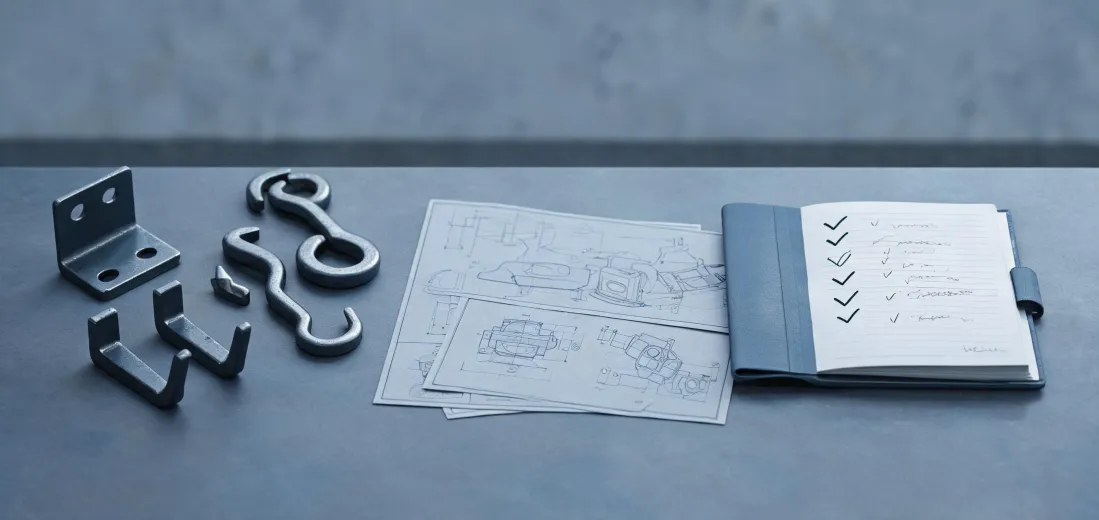
Last April, I was standing in the maintenance bay staring at a cracked swivel hook that had just failed a proof load test. The safety officer had the report in her hand. The hook was still bolted to the test rig, a hairline fracture running through the heel of the bow where the steel had silently let go.
It wasn't a Gunnebo hook. It wasn't even a hook we'd bought. It came from a second-hand gantry crane we'd purchased in 2019, disassembled and rebuilt on our fabrication floor. But I'm the one who signed off on the testing schedule, so the failure was mine to own.
Background: The Year We Outfitted a New Maintenance Bay
I'm the procurement manager at a 70-person marine fabrication shop. I manage our annual tooling and maintenance budget—about $180,000—and for six years, I've logged every invoice in our cost tracking spreadsheet. That habit is the only reason I can give you exact numbers for what happened next.
In Q2 2025, we were outfitting a new maintenance bay. I had a running list of equipment, and like most procurement lists, it was a mix of the tedious and the oddly interesting:
- Work benches with industrial drawers—I flipped through a drawer slides catalog and specified heavy-duty slides rated for constant shop use.
- An air hammer kit for frame repair—the 135maxk kit, which bundled the chisel set we needed for the metalwork.
- An impact wrench for fleet truck lug nuts—I spent an afternoon researching what size impact wrench is best for lug nuts on our F-550 fleet before settling on a 3/4" drive model.
And then there was the lifting gear. Our annual inspection had flagged several worn components: two bow shackles, a safety hook with a failing latch, and a swivel hook with visible scoring on the race. Nothing urgent. Normal wear for gear that works daily.
The Quote That Almost Got Me
Our regular rigging supplier quoted Gunnebo products for the replacements. Clean quote: $290 for the swivel hook assembly, $86 per shackle, $74 for the safety hook. About $1,120 total, with certificates of conformity included for every piece.
Then a new supplier cold-called me, promising to "beat any quote by 30%." The photos on his listing looked identical. Certificates were attached. He'd been emailing for months, and honestly, the timing was bad for my budget discipline. The maintenance bay equipment had all landed slightly above my estimates, so a 30% discount on rigging felt like an easy win.
The difference: $340. That was the amount I nearly sold out our lifting gear standards for.
The Test That Changed Everything
As I was still weighing the options, our insurance policy changed. The new carrier required a proof load test on all critical lifting gear—150% of rated load. The gantry hook was on the list, though none of us expected trouble. It had a valid inspection sticker. It looked perfect.
At roughly 60% of the test load, the inspector noticed it: a hairline crack at the heel of the hook, visible only under tension. When the load was released, the crack closed completely. That's the worst kind of defect, because it's invisible at rest and only appears when the steel is under strain.
Take the crane out of service. Quarantine the hook. Pull the inspection history on everything.
You can guess what we found.
Twelve more lifting components without verifiable certificates. Four shackles with batch numbers tracing to a supplier that no longer registered. A safety hook with markings so worn we couldn't identify the manufacturer at all. The insurance consultant gave us two options: replace every questionable component, or stop lifting operations entirely.
The Cost Breakdown
I tracked every line item, because that's what I do:
- Two days of fabrication floor shutdown while we swapped out critical gear and re-tested: $7,800 in lost production.
- The full replacement order—all Gunnebo products: swivel hooks, safety hooks, bow shackles, even the container lifting lugs we use for sea freight boxes: $2,150.
- Expedited shipping, because we couldn't wait for standard freight: $415.
- The consultant's complete audit report—now a required annual expense under our policy: $3,400.
Total: $13,765. For a component family we could have proactively replaced for roughly $1,120.
The certified Gunnebo swivel hook replacement—the one with the stamped batch number and EN 1677-1 conformity—would have cost $290. That's it. $290.
I keep coming back to that number.
Honest Uncertainties and Boundaries
I need to be clear about what I don't know. I can't tell you exactly why that hook developed a crack after years of service. My best guess is a past impact—something dropped or swung at some point before we owned the crane. The crack would have started then and grown slowly. Lifting gear wear is like that: the damage happens in one unremarkable moment, and the failure shows up years later.
I also don't want to suggest that inexpensive lifting hardware is automatically unsafe. There are reputable mid-range manufacturers that produce certified, traceable components. The factor that matters isn't price. It's verifiability. Can you prove what a component is rated for and who tested it? If yes, you're fine. If no, you can't actually know what you're paying for.
Personally, this approach worked for us because we're a single-site, mid-size operation with predictable usage patterns. If you're a rental company rotating lifting gear across multiple job sites, your traceability challenges are different from ours, and my checklist might not map cleanly to your work.
What We Changed
All new lifting gear is now from Gunnebo products—hooks, shackles, swivels, lugs. Not because it's the only brand that meets standards, but because batch traceability is practical. Every component carries a stamped batch number, and certificates of conformity are available on their web portal. I can pull documentation in three minutes instead of chasing suppliers for a week.
I also wrote a 12-point inspection checklist after this incident. It looks simple. It has already saved us an estimated $8,000 in potential rework. The checklist includes:
- Certificate of conformity on file for every component before first use
- Batch number legibility—if you can't read it, it's replaced, period
- Latch spring tension checked by hand, not by eye
- Swivel rotation tested under load, not just unloaded
- Proof load test dates mapped to actual usage hours, not just calendar dates
The policy: any component without a verifiable certificate is replaced on the spot, no exceptions. The shop staff pushed back at first—inspection bureaucracy is annoying. I get that. But the cost of one incident exceeded the combined cost of every proactive replacement we've made under this policy.
The Prevention Math
The upside of switching to the cheaper supplier was $340 in first-quarter savings. The downside was a potential $13,765 incident and, worse, a load dropped on someone's head. That's a 40:1 risk-to-reward ratio I was willing to accept—simply because I hadn't done the math at the time.
Now I frame it differently. Every dollar spent on certified, traceable lifting gear is insurance. You don't buy insurance because you expect the worst. You buy it because the worst is catastrophic and the premium is trivial by comparison.
Our annual spend on lifting gear is roughly $4,200—about 2.3% of my total budget. It protects the fabricated steel that moves through our facility, something in the neighborhood of $40 million a year. For a long time, I was focused on what that 2.3% cost instead of what it protected.
Cost of the status quo: one failed hook and a $13,765 lesson.
Cost of prevention: $150 more per component, and a full night's sleep.
I know which one I'd rather pay.