Last spring, our procurement team walked into my office with a spreadsheet that made me set my coffee down slowly. They'd found a supplier offering shackles at roughly 60% of what we were paying for genuine Gunnebo components. Same working load limit. Same nominal pin diameter. Same coating color. The supplier even attached a certificate of conformity that looked legitimate at a glance.
"These are equivalent," procurement said. "We could save about $9,000 on the project."
Honestly, the number caught my attention too. Nine grand is nine grand. But I didn't say yes, and I didn't say no. I asked for twelve samples.
What happened over the next three days changed the way we vet every lifting component that comes through our dock—and it's the reason "Gunnebo" is now written into the specification for every marine contract we quote.
The Backstory: 4,000 Components, One Tight Deadline
We're an authorized Gunnebo distributor, so lifting hardware is our core business. Last spring, we won a contract to supply roughly 4,000 shackles and lifting hooks for a marine installation project—three workstations plus spares. The hardware package was worth about $38,000 from our side. In the context of the customer's $1.2M project, that's not a massive line item, but every single component would be carrying load in an environment where failure doesn't just mean a schedule slip.
I manage quality and brand compliance for our company. My job is making sure nothing leaves our warehouse unless it matches the specification on the paperwork—and the paperwork matches the product. I've been doing this for four years, and I review roughly 200 unique deliveries annually. In our Q1 2024 quality audit, I rejected 6% of first deliveries from suppliers. Most were documentation gaps—missing heat number traces, vague certificates, unverifiable manufacturer names. But two batches had dimensional issues that a caliper would have caught in thirty seconds.
So when procurement said "equivalent," I didn't hear a conclusion. I heard a hypothesis that hadn't been tested yet.
The Side-by-Side Test
I asked our Gunnebo rep to confirm the critical spec points for the shackles we'd quoted—material grade, working load limit, bow dimensions, pin thread class, and marking requirements. Then I asked procurement to order twelve samples from the alternate supplier. Not one. Twelve. Same claimed size, same claimed grade, same claimed WLL.
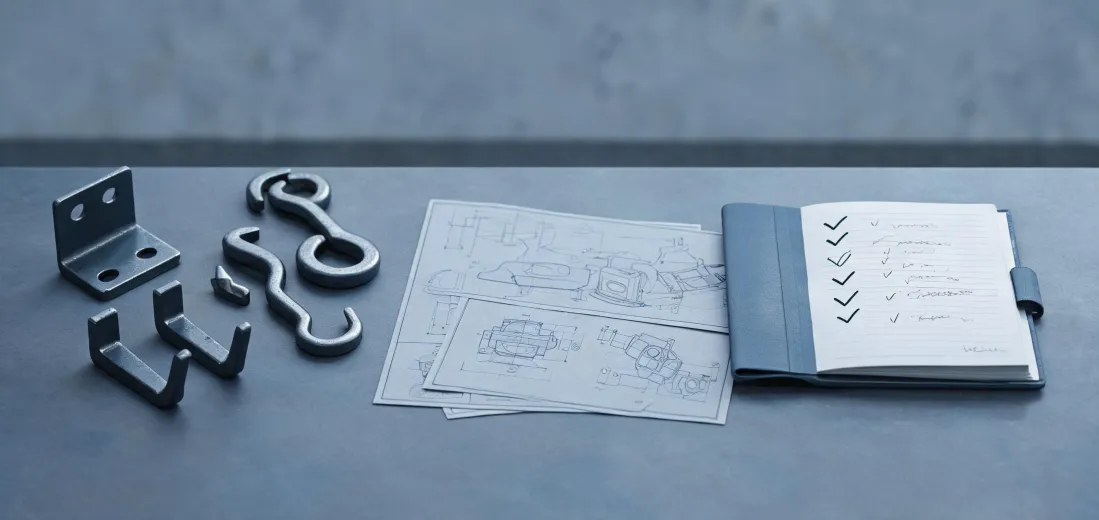
When both sets arrived, we laid them out on the inspection bench in our warehouse. It wasn't dramatic—just a steel table, a calibrated caliper, a surface plate, and thread gauges. The whole exercise took about 45 minutes for twenty-four units.
The Gunnebo shackles were almost boring. Pin thread starts were clean, bow crown heights stayed within 0.8 mm of each other, and the forged markings were legible on every single unit. That consistency is exactly why we spec Gunnebo lifting hooks and shackles for critical applications. It's not magic. It's process control.
The alternate shackles were a different story. The markings were rolled on, not forged, and legibility varied noticeably between units. One pin wouldn't thread past the second rotation by hand. Crown height across the twelve samples varied by 4.7 mm—on a nominal 76.2 mm (3-inch) bow profile, that's over a 6% spread. "Within tolerance" might describe some of these units, but "some" isn't a specification.
Then came the red flag. The certificate claimed compliance with ASME B30.26 and EN 1677, but the manufacturer named on the document didn't match the logo stamped on the shackles. The heat number format didn't trace to any registered source. That paper was probably issued for some product—just not the one sitting on our bench.
The Turning Point
I called procurement and told them straight: we're not accepting this batch, and we're not qualifying this source.
The predictable response came back: "But the price..."
I pulled up the numbers from our Q2 2024 rework report. Earlier that year, a low-cost rigging screw supplier's product developed plating failure after thirty days in storage. We didn't catch it until the components were already staged for installation. The replacement, expedited shipping, and lost labor totaled $22,000 on an original $14,000 purchase.
"5 minutes of verification beats 5 days of correction."
I've used that line more times than I can count since then. It's not a slogan—it's a cost model.
What the Comparison Actually Showed
We placed the full order with Gunnebo the following week. Yes, we paid a premium. The alternate supplier was genuinely cheaper, and I won't pretend otherwise. But the total cost of ownership wasn't cheaper once you factored in verification, schedule risk, and the consequences of a component failure in the field.
Here's the breakdown we shared in our quarterly review:
- Alternate supplier savings: ~$9,000 on the purchase order
- Testing and verification labor: ~$1,100 (our time plus an outside lab for certificate traceability)
- Schedule delay risk if the batch failed post-installation: 3–6 weeks on a marine project, estimated at $18,000–$24,000 per week in contract penalties
- Safety consequence: not quantifiable in dollars. That's the whole point.
Seeing those figures side by side made me finally understand why the details matter so much. The $9,000 savings would have disappeared the moment we needed to redo a single installation week. And the worst-case scenario isn't a line item at all—it's a failure that ends careers and puts people in the hospital.
The Lesson: Verification Is the Cheapest Insurance
I'm not saying every non-branded lifting component is dangerous. I'm not saying every "equivalent" is a counterfeit. But I am saying that verification is not a formality. It's a check that pays for itself every single time it catches a problem.
Our protocol now, for any lifting component that isn't sourced from an authorized Gunnebo distributor, includes:
- Certificate traceability check. Manufacturer name on the cert vs. stamped logo on the part, heat number format, and issuing body.
- Dimensional sampling per ASME B30.26. Bow width, crown height, pin diameter, and thread fit.
- Marking verification. Method (forged vs. rolled), legibility, and depth.
- Destructive load test. One sample per 1,000 units for any new vendor without prior history.
The full list takes about 45 minutes for a batch of 1,000. I've seen the alternative. In 2022, before we tightened these criteria, we accepted a shipment from a new vendor whose documentation looked excellent. Within three weeks, surface corrosion developed under the plating, and 8,000 units were ruined in storage. We lost the order value—and we paid for disposal and re-sourcing at a premium with expedited delivery.
Within two quarters, the impact was measurable. When I compared our Q1 2024 supplier audit results to Q4, our first-delivery rejection rate dropped by 11%, and our carrying costs actually went down—because we stopped paying for unverified stock that sat in storage while we chased documentation.
The Gunnebo order, by contrast, completed with zero non-conformances across 4,000 units. That's the consistency you're actually paying for when you put "Gunnebo" on a specification. It isn't just the steel or the forging. It's the fact that every unit matches the drawing, and the documentation matches the units.
Your Mileage May Vary
I can only speak to our context—a mid-size distributor with predictable ordering patterns and a marine and construction focus. If you're an OEM forging your own components in-house, with full control over metallurgy and heat treatment, you're facing a different set of variables. The calculus might be different for you.
I also respect that budget constraints are real. I've sat in rooms where the choice was framed as "cheaper components or no project at all," and I won't pretend that's an easy position. What I can tell you is this: the cost of checking is small, the cost of replacing is larger, and the cost of a lifting failure is in a category that doesn't compare to either.
Bottom line: "equivalent" is a claim, not a specification. And claims are exactly what a quality process is designed to verify.